
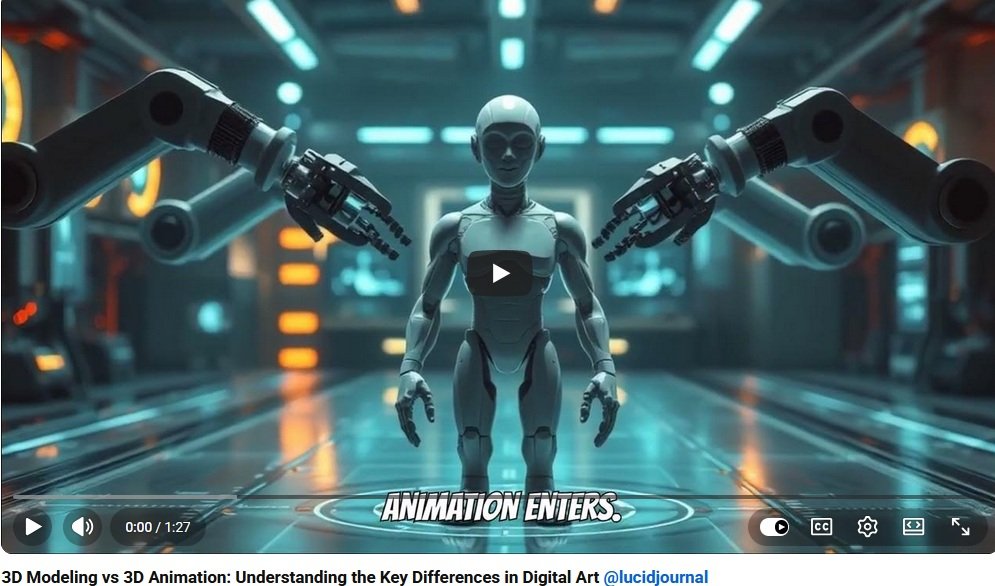
Many beginners entering the world of digital art assume that 3D modeling and 3D animation are the same thing. While the two disciplines work closely together, they are actually very different skills that serve distinct purposes within the 3D video production process.
Understanding the difference between modeling and animation is essential for anyone interested in creating 3D videos, animated films, game cinematics, product visualizations, virtual reality experiences, or visual effects. Both skills are important, but they focus on different stages of production.
For students at 3DArtSchool.org, learning how these disciplines fit together provides a clearer understanding of the professional 3D production pipeline and helps identify which areas may be the most interesting for future specialization.
What Is 3D Modeling?
3D modeling is the process of creating digital objects in three-dimensional space. A model is the foundation of everything that appears in a 3D scene. Before anything can move, it must first exist as a model.
Modelers build digital versions of:
- Characters
- Vehicles
- Buildings
- Furniture
- Products
- Landscapes
- Props
- Machines
- Creatures
Think of a 3D model as a digital sculpture. The model gives an object shape, size, volume, and structure.
How 3D Models Are Created
3D models are built using specialized software. Artists manipulate points, edges, polygons, curves, and surfaces to form digital objects.
Popular modeling techniques include:
- Polygon modeling
- Subdivision modeling
- Sculpting
- NURBS modeling
- Procedural modeling
- Photogrammetry
Each method has strengths depending on the type of project being created.
Skills Needed for 3D Modeling
Successful modelers often develop skills in:
- Shape design
- Anatomy
- Architecture
- Mechanical design
- Topology
- Scale and proportion
- Digital sculpting
- Surface detail creation
Modeling requires patience, attention to detail, and strong visual observation skills.
What Is 3D Animation?
3D animation is the process of bringing digital objects to life through movement. Once models have been created, animators control how those objects move, interact, and behave over time.
Animation creates the illusion of life and motion.
Animators may create movement for:
- Characters
- Animals
- Vehicles
- Cameras
- Machines
- Products
- Special effects
- Environmental elements
Without animation, even the most detailed models remain static objects.
How 3D Animation Works
Most 3D animation uses keyframes. Keyframes define important positions at specific points in time. The software calculates movement between those positions.
For example:
- A character walks across a room.
- A vehicle drives down a road.
- A camera flies through a building.
- A logo spins into view.
- A product rotates for demonstration.
Animation transforms digital objects into dynamic visual experiences.
Skills Needed for 3D Animation
Successful animators often develop expertise in:
- Timing
- Movement
- Acting
- Storytelling
- Physics
- Body mechanics
- Facial expressions
- Visual communication
Animators focus less on building objects and more on making those objects move in believable and engaging ways.
The Core Difference Between Modeling and Animation
The simplest way to understand the difference is this:
- Modeling creates the object.
- Animation makes the object move.
A modeler might create a dragon. An animator would make the dragon walk, fly, roar, and interact with its environment.
A modeler might build a sports car. An animator would make the car race down a highway.
A modeler creates the stage. An animator performs the show.
How Modeling and Animation Work Together
Professional 3D productions require both disciplines. Modeling and animation are not competing skills—they are complementary skills.
The typical workflow looks like this:
- Create the concept.
- Build the 3D models.
- Add materials and textures.
- Create rigs if needed.
- Animate the models.
- Add lighting.
- Render the scenes.
- Edit the final video.
Each stage depends on the previous stage being completed successfully.
What Is Rigging?
Between modeling and animation sits an important process called rigging.
Rigging creates a digital skeleton or control system that allows a model to move properly.
Rigging controls:
- Arms and legs
- Hands and fingers
- Facial expressions
- Spines
- Mechanical parts
- Vehicle controls
Without rigging, animators would have difficulty creating realistic movement for complex objects.
Examples of Modeling Projects
Modelers often focus on projects such as:
- Character creation
- Fantasy creatures
- Architectural buildings
- Vehicles
- Furniture
- Product visualizations
- Environmental assets
- Game objects
Modelers spend much of their time refining shapes, details, and structures.
Examples of Animation Projects
Animators often work on:
- Character performances
- Walking cycles
- Running animations
- Facial expressions
- Product demonstrations
- Camera movements
- Vehicle animations
- Special effects sequences
The animator's goal is to create movement that feels natural, expressive, and visually appealing.
Career Paths for 3D Modelers
People who enjoy creating objects and environments may choose careers such as:
- 3D Modeler
- Character Artist
- Environment Artist
- Prop Artist
- Architectural Modeler
- Product Visualization Artist
- Digital Sculptor
- Game Asset Creator
These professionals focus primarily on building assets used in larger projects.
Career Paths for 3D Animators
Artists who enjoy storytelling and movement often pursue careers such as:
- 3D Animator
- Character Animator
- Motion Graphics Artist
- Cinematic Animator
- Visual Effects Animator
- Virtual Production Artist
- Product Animation Specialist
- Game Animator
Animators bring life and emotion to digital worlds.
Can One Person Learn Both?
Absolutely. Many independent creators, freelancers, and small studio artists learn both modeling and animation. Modern software allows individuals to complete entire projects themselves.
Learning both skills provides several advantages:
- Greater creative control
- More career opportunities
- Improved problem-solving abilities
- Better understanding of the full production pipeline
- Ability to create complete projects independently
Many successful YouTube creators, freelancers, and digital artists combine both disciplines.
Which Skill Should Beginners Learn First?
The answer depends on personal interests.
If you enjoy creating objects, characters, architecture, and environments, start with modeling.
If you enjoy movement, acting, storytelling, and bringing scenes to life, start with animation.
Many beginners start with basic modeling because animation requires something to animate. However, learning simple animation early can help maintain motivation and provide quick creative results.
Software Used for Modeling and Animation
Many professional software packages support both disciplines.
- Blender
- Autodesk Maya
- Cinema 4D
- 3ds Max
- Houdini
- Unreal Engine
- Unity
Blender remains one of the most popular choices for beginners because it includes modeling, rigging, animation, rendering, and editing tools in a single free application.
How Modeling and Animation Fit into the Full Production Pipeline
Professional 3D video production involves many specialized roles:
- Concept Artists
- Modelers
- Texture Artists
- Rigging Artists
- Animators
- Lighting Artists
- Visual Effects Artists
- Editors
- Compositors
Modeling and animation represent two of the most important stages in this pipeline.
Final Thoughts
Understanding the difference between 3D modeling and 3D animation is essential for anyone interested in creating digital content. Modeling focuses on building objects, characters, and environments. Animation focuses on bringing those creations to life through movement and storytelling.
Both disciplines are valuable, creative, and rewarding. Some artists specialize in one area, while others learn both to create complete projects independently.
For students at 3DArtSchool.org, exploring both modeling and animation provides a strong foundation for careers in film, gaming, visual effects, architecture, product design, and digital media. Together, these skills form the backbone of modern 3D video production.
3D Video Creation Related Articles