
3D Modeling vs 3D Animation: Understanding the Video Production Pipeline
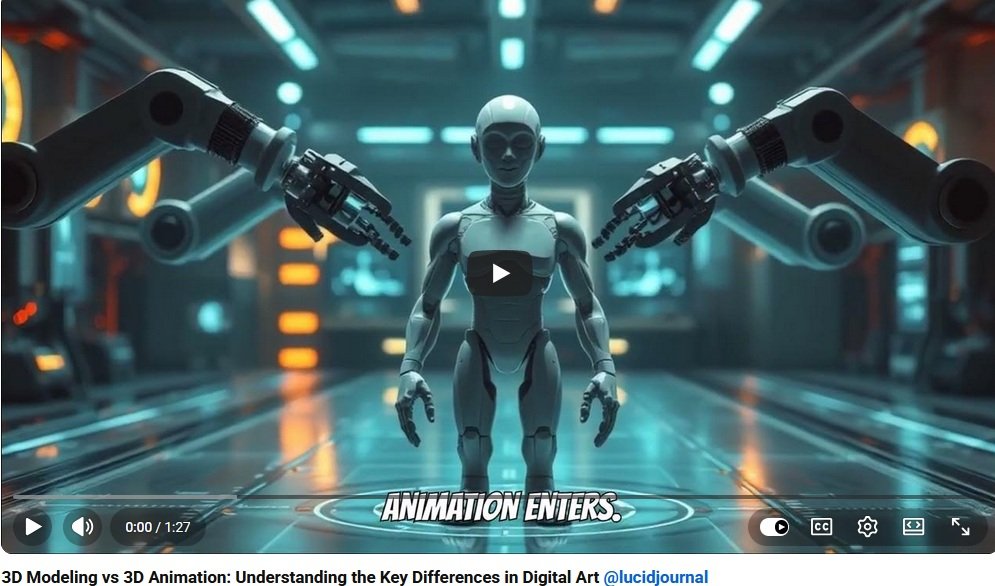
Many beginners entering the world of digital art assume that 3D modeling and 3D animation are the same thing. While the two disciplines work closely together, they are actually very different skills that serve distinct purposes within the 3D video production process.
Understanding the difference between modeling and animation is essential for anyone interested in creating 3D videos, animated films, game cinematics, product visualizations, virtual reality experiences, or visual effects. Both skills are important, but they focus on different stages of production.
For students at 3DArtSchool.org, learning how these disciplines fit together provides a clearer understanding of the professional 3D production pipeline and helps identify which areas may be the most interesting for future specialization.
What Is 3D Modeling?
3D modeling is the process of creating digital objects in three-dimensional space. A model is the foundation of everything that appears in a 3D scene. Before anything can move, it must first exist as a model.
Modelers build digital versions of:
- Characters
- Vehicles
- Buildings
- Furniture
- Products
- Landscapes
- Props
- Machines
- Creatures
Think of a 3D model as a digital sculpture. The model gives an object shape, size, volume, and structure.
How 3D Models Are Created
3D models are built using specialized software. Artists manipulate points, edges, polygons, curves, and surfaces to form digital objects.
Popular modeling techniques include:
- Polygon modeling
- Subdivision modeling
- Sculpting
- NURBS modeling
- Procedural modeling
- Photogrammetry
Each method has strengths depending on the type of project being created.
Skills Needed for 3D Modeling
Successful modelers often develop skills in:
- Shape design
- Anatomy
- Architecture
- Mechanical design
- Topology
- Scale and proportion
- Digital sculpting
- Surface detail creation
Modeling requires patience, attention to detail, and strong visual observation skills.
What Is 3D Animation?
3D animation is the process of bringing digital objects to life through movement. Once models have been created, animators control how those objects move, interact, and behave over time.
Animation creates the illusion of life and motion.
Animators may create movement for:
- Characters
- Animals
- Vehicles
- Cameras
- Machines
- Products
- Special effects
- Environmental elements
Without animation, even the most detailed models remain static objects.
How 3D Animation Works
Most 3D animation uses keyframes. Keyframes define important positions at specific points in time. The software calculates movement between those positions.
For example:
- A character walks across a room.
- A vehicle drives down a road.
- A camera flies through a building.
- A logo spins into view.
- A product rotates for demonstration.
Animation transforms digital objects into dynamic visual experiences.
Skills Needed for 3D Animation
Successful animators often develop expertise in:
- Timing
- Movement
- Acting
- Storytelling
- Physics
- Body mechanics
- Facial expressions
- Visual communication
Animators focus less on building objects and more on making those objects move in believable and engaging ways.
The Core Difference Between Modeling and Animation
The simplest way to understand the difference is this:
- Modeling creates the object.
- Animation makes the object move.
A modeler might create a dragon. An animator would make the dragon walk, fly, roar, and interact with its environment.
A modeler might build a sports car. An animator would make the car race down a highway.
A modeler creates the stage. An animator performs the show.
How Modeling and Animation Work Together
Professional 3D productions require both disciplines. Modeling and animation are not competing skills—they are complementary skills.
The typical workflow looks like this:
- Create the concept.
- Build the 3D models.
- Add materials and textures.
- Create rigs if needed.
- Animate the models.
- Add lighting.
- Render the scenes.
- Edit the final video.
Each stage depends on the previous stage being completed successfully.
What Is Rigging?
Between modeling and animation sits an important process called rigging.
Rigging creates a digital skeleton or control system that allows a model to move properly.
Rigging controls:
- Arms and legs
- Hands and fingers
- Facial expressions
- Spines
- Mechanical parts
- Vehicle controls
Without rigging, animators would have difficulty creating realistic movement for complex objects.
Examples of Modeling Projects
Modelers often focus on projects such as:
- Character creation
- Fantasy creatures
- Architectural buildings
- Vehicles
- Furniture
- Product visualizations
- Environmental assets
- Game objects
Modelers spend much of their time refining shapes, details, and structures.
Examples of Animation Projects
Animators often work on:
- Character performances
- Walking cycles
- Running animations
- Facial expressions
- Product demonstrations
- Camera movements
- Vehicle animations
- Special effects sequences
The animator's goal is to create movement that feels natural, expressive, and visually appealing.
Career Paths for 3D Modelers
People who enjoy creating objects and environments may choose careers such as:
- 3D Modeler
- Character Artist
- Environment Artist
- Prop Artist
- Architectural Modeler
- Product Visualization Artist
- Digital Sculptor
- Game Asset Creator
These professionals focus primarily on building assets used in larger projects.
Career Paths for 3D Animators
Artists who enjoy storytelling and movement often pursue careers such as:
- 3D Animator
- Character Animator
- Motion Graphics Artist
- Cinematic Animator
- Visual Effects Animator
- Virtual Production Artist
- Product Animation Specialist
- Game Animator
Animators bring life and emotion to digital worlds.
Can One Person Learn Both?
Absolutely. Many independent creators, freelancers, and small studio artists learn both modeling and animation. Modern software allows individuals to complete entire projects themselves.
Learning both skills provides several advantages:
- Greater creative control
- More career opportunities
- Improved problem-solving abilities
- Better understanding of the full production pipeline
- Ability to create complete projects independently
Many successful YouTube creators, freelancers, and digital artists combine both disciplines.
Which Skill Should Beginners Learn First?
The answer depends on personal interests.
If you enjoy creating objects, characters, architecture, and environments, start with modeling.
If you enjoy movement, acting, storytelling, and bringing scenes to life, start with animation.
Many beginners start with basic modeling because animation requires something to animate. However, learning simple animation early can help maintain motivation and provide quick creative results.
Software Used for Modeling and Animation
Many professional software packages support both disciplines.
- Blender
- Autodesk Maya
- Cinema 4D
- 3ds Max
- Houdini
- Unreal Engine
- Unity
Blender remains one of the most popular choices for beginners because it includes modeling, rigging, animation, rendering, and editing tools in a single free application.
How Modeling and Animation Fit into the Full Production Pipeline
Professional 3D video production involves many specialized roles:
- Concept Artists
- Modelers
- Texture Artists
- Rigging Artists
- Animators
- Lighting Artists
- Visual Effects Artists
- Editors
- Compositors
Modeling and animation represent two of the most important stages in this pipeline.
Final Thoughts
Understanding the difference between 3D modeling and 3D animation is essential for anyone interested in creating digital content. Modeling focuses on building objects, characters, and environments. Animation focuses on bringing those creations to life through movement and storytelling.
Both disciplines are valuable, creative, and rewarding. Some artists specialize in one area, while others learn both to create complete projects independently.
For students at 3DArtSchool.org, exploring both modeling and animation provides a strong foundation for careers in film, gaming, visual effects, architecture, product design, and digital media. Together, these skills form the backbone of modern 3D video production.
3D Video Creation Related Articles
The 10 Essential Skills Every 3D Video Creator Must Learn
Becoming a skilled 3D video creator takes more than learning one software program. Great 3D videos combine art, storytelling, technology, motion, lighting, sound, and careful planning. Whether you want to create animated short films, product videos, game cinematics, educational animations, virtual reality scenes, or social media content, you need a strong foundation in the essential skills of 3D video production.
For beginners at 3DArtSchool.org, the good news is that these skills can be learned step by step. You do not need to master everything overnight. By focusing on one skill at a time, you can grow from a beginner into a confident 3D artist and video creator.
1. Storytelling and Concept Development
Every successful 3D video begins with a clear idea. Before modeling characters or animating scenes, a 3D video creator must understand the purpose of the video. Is it meant to entertain, teach, sell a product, explain a concept, or create an emotional experience?
Strong storytelling helps guide the entire production. Even a short 10-second animation should have a beginning, middle, and end. A product video may tell the story of how an item solves a problem. A character animation may show emotion through movement. An educational animation may explain a complex idea in a simple visual way.
Important storytelling skills include:
- Developing a clear concept
- Understanding the audience
- Creating a simple message
- Planning emotional impact
- Building visual flow
- Writing short scripts or scene outlines
2. Storyboarding and Pre-Production Planning
Storyboarding is one of the most important skills every 3D video creator must learn. A storyboard is a visual plan that shows the major shots, camera angles, actions, and transitions in the video.
Pre-production planning saves time and prevents confusion later. Without planning, beginners often waste hours building scenes that do not support the final story.
Storyboarding helps with:
- Shot composition
- Scene order
- Camera placement
- Character action
- Timing and pacing
- Production organization
You do not need to be a perfect illustrator to create storyboards. Simple sketches, notes, and arrows are enough to guide the animation process.
3. 3D Modeling
3D modeling is the process of creating digital objects used in a video. These objects may include characters, vehicles, buildings, furniture, products, props, environments, or fantasy creatures.
Strong modeling skills allow a 3D video creator to build scenes that match the project vision. Beginners often start with simple shapes and gradually move into more detailed models.
Common modeling skills include:
- Creating basic shapes
- Using polygons and curves
- Building clean geometry
- Modeling props and environments
- Creating characters
- Understanding scale and proportion
Clean models are easier to texture, rig, animate, and render. Good modeling habits make the entire production process smoother.
4. Texturing and Materials
After a model is built, it needs surface detail. Texturing and materials make 3D objects look like wood, metal, glass, fabric, stone, skin, plastic, or painted surfaces.
A simple model can look professional when it has strong materials and realistic textures. On the other hand, a detailed model can look unfinished if the textures are weak.
Important material skills include:
- Choosing base colors
- Creating roughness and shine
- Using texture maps
- Adding realistic surface details
- Understanding reflections
- Creating stylized looks
Texturing is especially important for product videos, game assets, realistic animation, and cinematic scenes.
5. Rigging
Rigging is the process of adding a digital skeleton or control system to a 3D model so it can move. Characters, animals, robots, vehicles, and mechanical objects often need rigs before they can be animated properly.
For character animation, rigging controls arms, legs, hands, facial expressions, body posture, and movement. For product animation, rigging may control moving parts, rotating components, hinges, wheels, or mechanical functions.
Basic rigging skills include:
- Creating bones or joints
- Setting movement controls
- Weight painting
- Building facial controls
- Testing deformations
- Preparing models for animation
Beginners can start by using pre-rigged characters while learning animation, then gradually study rigging as their skills improve.
6. Animation and Motion
Animation is the heart of 3D video creation. It brings characters, objects, cameras, and environments to life. A skilled 3D video creator understands how to make movement feel natural, expressive, and visually interesting.
Animation often uses keyframes, which mark important positions over time. The software creates movement between those keyframes, but the artist controls timing, spacing, rhythm, and emotion.
Important animation skills include:
- Keyframe animation
- Timing and spacing
- Character movement
- Object motion
- Camera animation
- Facial expressions
- Physics-based motion
Good animation does not simply move objects. It communicates weight, personality, purpose, and story.
7. Lighting and Cinematography
Lighting can completely change the quality of a 3D video. A well-lit scene feels professional, emotional, and visually clear. Poor lighting can make even good models and animation look flat or confusing.
3D lighting works much like real-world film lighting. Artists use light placement, shadows, contrast, color, and brightness to guide the viewer’s eye.
Important lighting skills include:
- Three-point lighting
- Cinematic lighting
- Natural daylight simulation
- Shadow control
- Color mood
- Depth and contrast
- Camera composition
Cinematography is also important. Camera angles, lens choices, framing, and movement help create a professional visual style.
8. Rendering
Rendering is the process of converting a 3D scene into final video frames. During rendering, the computer calculates lighting, shadows, reflections, textures, motion blur, and visual detail.
A 3D video creator must understand render settings because they affect both quality and production time. High-quality rendering can look beautiful but may take longer. Fast rendering may save time but reduce realism.
Rendering skills include:
- Choosing render engines
- Adjusting resolution
- Balancing speed and quality
- Using samples and denoising
- Managing reflections and shadows
- Exporting image sequences or video files
Learning rendering helps artists finish projects efficiently without sacrificing visual quality.
9. Video Editing and Sound Design
After rendering, the animation must be edited into a final video. Editing controls pacing, transitions, music, narration, sound effects, titles, and final polish.
Sound design is especially important because audio can make animation feel more believable and emotional. Even a simple 3D scene becomes more engaging when it includes proper sound effects and music.
Editing skills include:
- Cutting scenes together
- Adding music
- Using sound effects
- Adding voice-over narration
- Creating titles
- Color correction
- Exporting for web, social media, or clients
A strong edit can turn separate animated shots into a smooth and professional final production.
10. Visual Effects and Problem Solving
Visual effects can add excitement and polish to 3D videos. Effects may include smoke, fire, water, particles, explosions, glowing energy, weather, magic, dust, or motion graphics.
Not every project needs complex effects, but understanding basic visual effects gives creators more creative options.
Useful visual effects skills include:
- Particle systems
- Smoke and fire simulation
- Water effects
- Glow and light effects
- Compositing
- Motion graphics
- Green screen integration
Problem solving is just as important. Every 3D video project includes technical challenges. Successful artists learn how to troubleshoot, test, adjust, and keep moving forward.
Bonus Skill: Learning Software Efficiently
Software is the tool, not the art itself. A 3D video creator should learn how to use software efficiently without becoming overwhelmed by every feature.
Popular software tools include:
- Blender
- Autodesk Maya
- Cinema 4D
- Unreal Engine
- Unity
- After Effects
- DaVinci Resolve
- Adobe Premiere Pro
Beginners should choose one main 3D program and learn the basics before jumping between too many tools.
How to Practice These Skills
The best way to improve is by creating small finished projects. Instead of trying to make a full animated movie right away, practice short assignments that focus on one skill at a time.
Beginner practice ideas include:
- Create a bouncing ball animation.
- Model a simple room.
- Animate a spinning product.
- Create a short camera fly-through.
- Light a dramatic scene.
- Render a 10-second animation.
- Edit a short video with music and sound effects.
Each completed project builds confidence and teaches the full creative process.
Why These Skills Matter for Careers
The essential skills of 3D video creation apply to many creative careers. Artists who understand modeling, animation, lighting, rendering, editing, and storytelling can work in entertainment, education, marketing, architecture, gaming, product design, and online media.
Career paths may include:
- 3D animator
- Motion graphics artist
- Visual effects artist
- Game cinematic artist
- Product visualization designer
- Architectural visualization artist
- Character artist
- Video editor
- Digital content creator
Final Thoughts
The 10 essential skills every 3D video creator must learn are storytelling, storyboarding, modeling, texturing, rigging, animation, lighting, rendering, editing, and visual effects. Together, these skills form the foundation of professional 3D video production.
Do not feel pressured to master everything immediately. Start with simple projects, practice consistently, and improve one skill at a time. Every finished animation teaches you something new.
With patience, creativity, and steady practice, beginners can grow into skilled 3D video creators capable of producing impressive animations, cinematic scenes, product videos, and digital stories.
3D Video Creation Related Articles